Machetes are perfect tools for literally any job, where a regular knife doesn't
do the trick. Thanks to their dimensions, they can also take the role of a
proper axe. So whether you are an avid gardener, embark on exciting expeditions
or just want to have a solid piece of iron (or rather high-quality steel)
nearby, a machete is definitely a must-have in your kit.
When it comes to the word "Machete", everyone probably knows it's basically just a larger knife with a long blade. However, there are countless types of machetes of various shapes, dimensions and features. Now the question is, how to choose the right machete that suits you the best?
machete types
You can come across a wide range of machetes in many different parts of the world. Each culture uses machetes for their specific needs, therefore their design has changed over time to best serve their purpose.
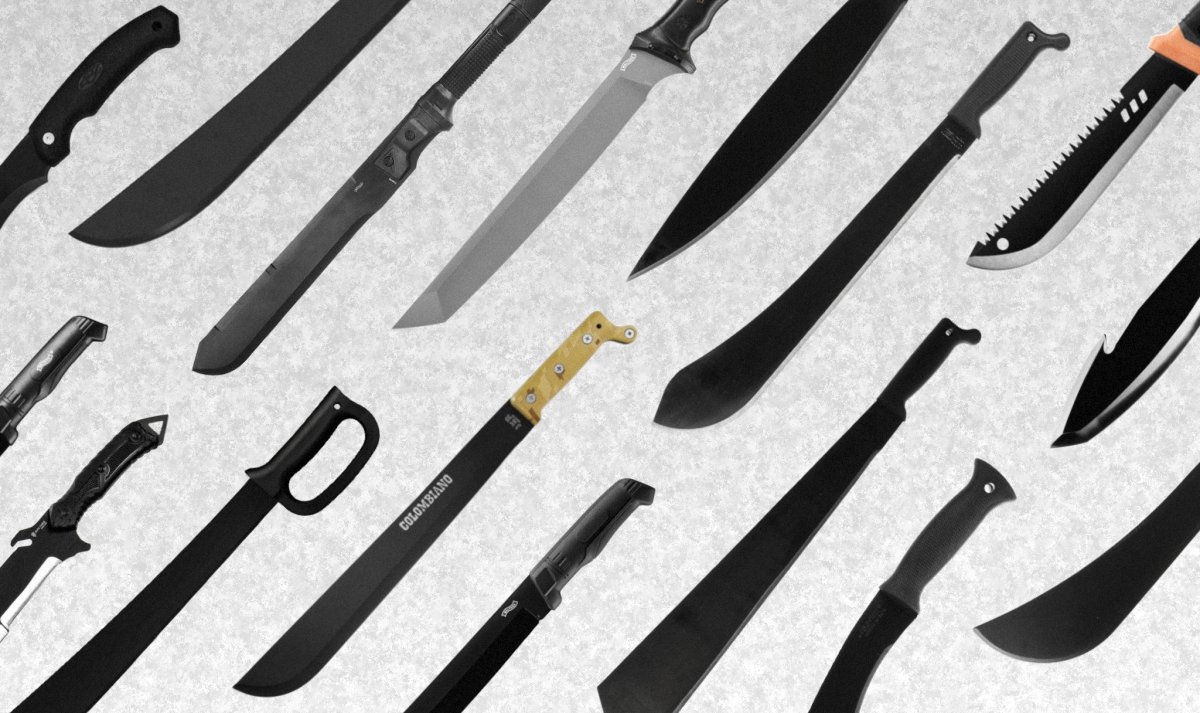
Some of the most familiar and most commonly used types of machetes include:
Latin
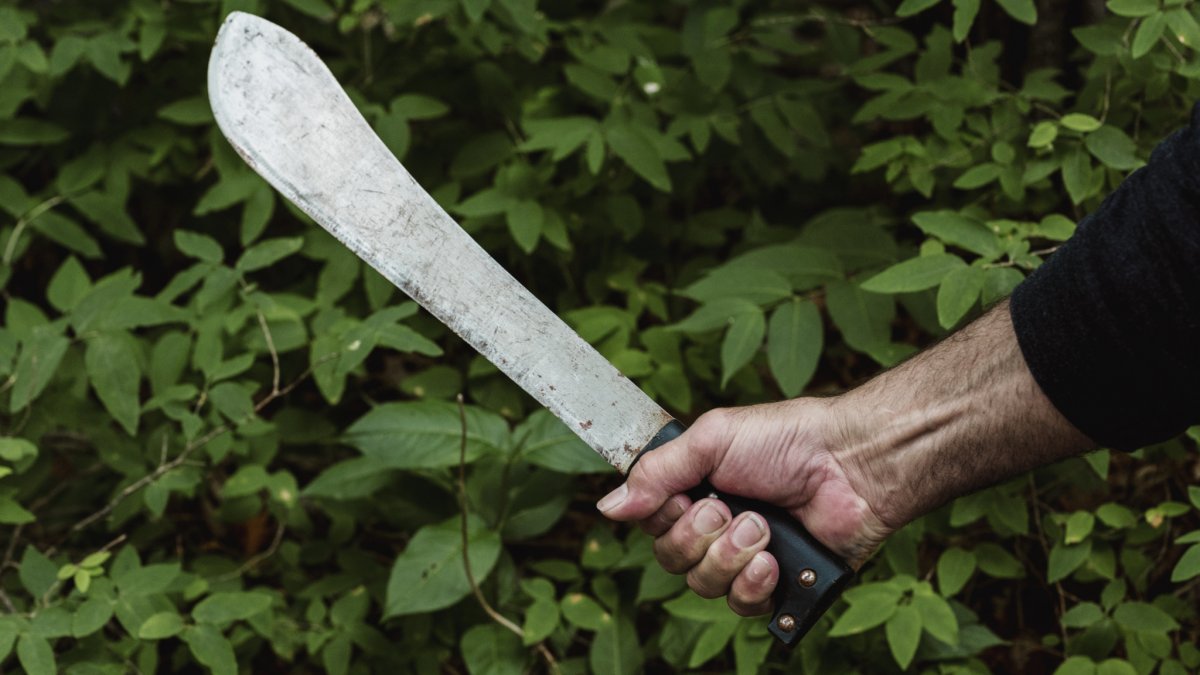
Also called "Bush" - probably the first type we think of when hearing the word machete. It is, in fact, the most widespread type in the West as well as in Europe, and for a good reason. It's a powerful and versatile tool for any sort of wood cutting and clearing thick vegetation. It is mostly available with a straight, smooth blade which is curved at the end with a slightly increasing blade height. Some manufacturers also offer machetes with the other side of the blade being serrated, serving as a wood saw. The serrations can be either single-row or alternated - making it even easier to saw wood. The handle is usually one-handed and its end features a rounded tip or is widened for a more secure grip.
Sometimes called "Khukuri". Originating in the borderlands of Nepal and India, this machete, or rather a Gurkha traditional weapon, is distinctive by its curved blade with a significant widening towards the sharp tip. Its shape, and therefore its weight distribution (the centre of gravity is located beyond the middle of the blade), makes it very easy to chop wood or cut meat without any effort.
This is a curved machete for multi-purpose use. It has a durable polymer handle
with a rubberized surface and a stainless steel blade with a length of 30 cm.
5 pcs in stock,
estimated delivery:
September 16 - 18.
The American company Cold Steel is bringing to the market a machete inspired by
the traditional weapon of the Nepalese Gurkhas – the Kukri. A truly
formidable cold weapon.
This curved machete with its signature "Sheepsfoot" blade tip comes from Malaysia. Its main purpose was to hack through dense vegetation. However, its shape also makes it the perfect tool for cutting meat and other meals. The handle is curved at the end for a better grip.
Golok
An Indonesian tool very similar to the Parang machete, sometimes even called the same. However, it features a different blade tip, comparable to the "Straight-back" type. Due to the similar design, it is also used for the same purpose - hacking through vegetation.
Bolo
Originating in the Philippines, this machete is still very popular throughout Southeast Asia as a crop harvesting tool. It is somewhat similar to the Latin/Bush machete, but is shorter, lighter and has a more robust blade end. It is therefore suitable for chopping wood as well as for more delicate tasks.
Panga
The Panga machetes originated in Africa, but gained their popularity in the Caribbean as sugar cane harvesting tools. They feature a straight blade with a strong curve at the end, which also makes them perfect for cutting branches.
Tapanga
Tapanga is rather just another variant of Panga. What makes it different is the "chopped off" tip. Just like the Panga, this type is also designed for harvesting crops.
Barong
A machete with a broad, leaf-shaped blade. It originates in the Philippines, where it has been used both for harvesting crops and as a terrifying weapon. The handle is heavily curved at the end to prevent it from slipping out of the user's hand.
Billhook
A versatile tool particularly useful for cutting smaller trees or removing branches from logs. This machete can be recognised at first sight - it has a heavily curved end of the blade, sharpened from the inner side.
Falcata
The Falcata machete is based on the sword of the same name, which was widely used in the Iberian peninsula in the times BC. The robust blade with elegant curves is suitable for chopping wood, harvesting crops and cutting through vegetation.
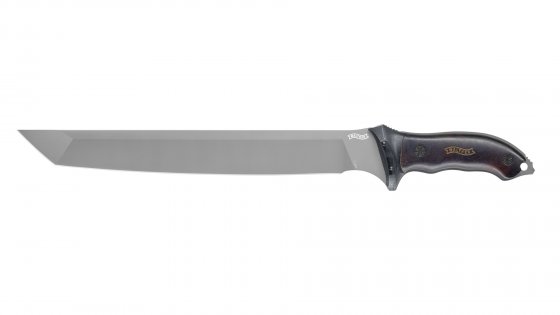
These days, a lot of machete producers experiment with all sorts of shapes, features and other innovations, therefore some machetes cannot be assigned to any specific category. Some of the most interesting products are made by the well-known manufacturers Cold Steel or Walther.
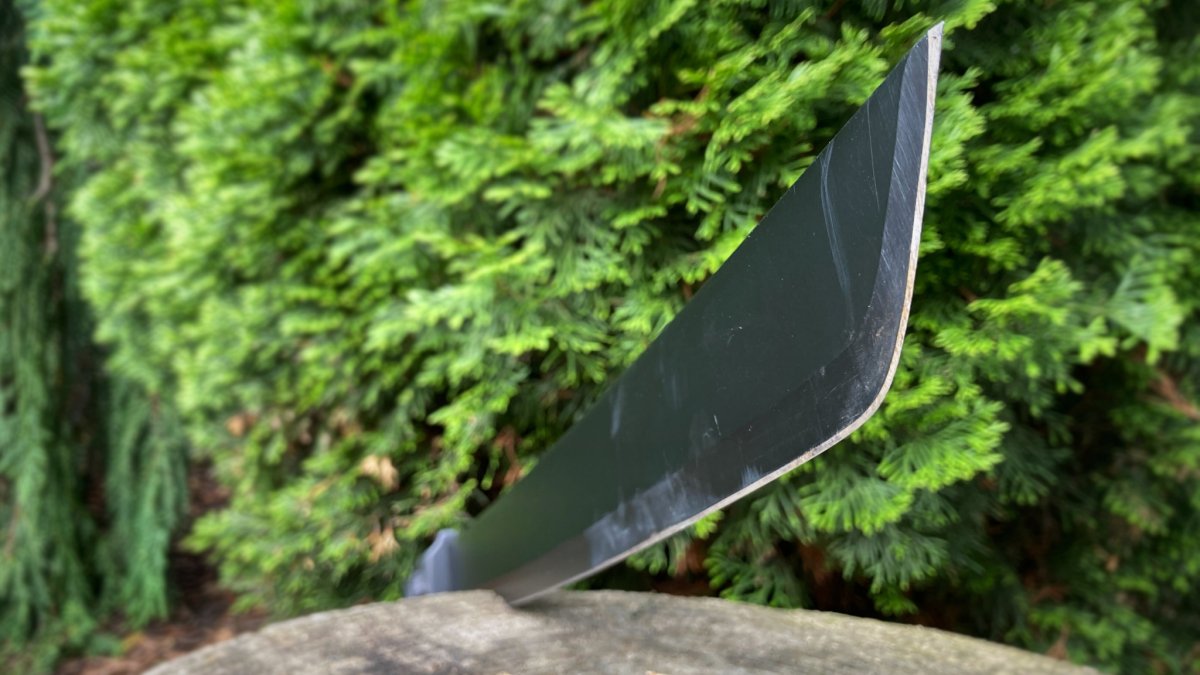
The most essential part of every machete is, obviously, the blade. It can have different length, thickness, construction, combined or smooth blade and let's not forget about the materials it is made of.
the material
The traditional machetes were made from materials that were available in their respective areas of origin. Nowadays, machete producers use high quality steel that contains carbon, chromium and other additives that affect the characteristics of the blade.
The most commonly used materials today are:
Carbon steel
The hardest and toughest type of steel - the higher the percentage of carbon, the greater the hardness. It is easy to sharpen, highly durable, and has overall excellent cutting ability. However, the carbon steel's major downside is its proneness to rust and corrosion and the necessary maintenance that goes with it. However, if you only want to use the machete as a trustworthy work tool and don't mind the occasional maintenance, carbon steel is the way to go.
Stainless steel
It contains at least 10.5% of chromium, which makes the steel corrosion-resistant. As a result, it does not require as frequent maintenance as carbon steel. However, the downside of stainless steel is that it is less wear-resistant, it is harder to sharpen and it is also more expensive than carbon steel.
the length
It is generally stated that the longer the blade, the better. But it also depends on the purpose of the machete and the needs of the user. With a longer blade, you can obviously reach further, which is particularly useful for cutting tall grass without having to bend down so much. However, as the blade length increases, the total weight does too, and the user will get tired more quickly. Storability is another important factor. Some people prefer shorter machetes that can easily fit into a side sheath and offer good manoeuvrability.
The thickness
The blade thickness is yet another important variable. It affects the weight of the blade and thus its ability to cut wood or other materials and, most importantly, its durability. Machetes with thicker blade are suitable for chopping wood because the blade can withstand severe impacts. On the other hand, for harvesting crops or cutting through vegetation, machetes with a thinner blade will do the job really well.
Full-Tang
While browsing machetes and knives, you've probably already came across the term "Full-Tang". But what exactly does it mean? It means that the blade and the inner part of the handle are one piece, giving the tool an extremely high durability so you won't be left with only the handle in your hand when chopping wood or doing other heavy work one day. There is also the Partial-Tang construction, where the blade is extended in the handle area only by a wedge "tang" and secured with glue, screws or rivets.
the handle
The blade alone will not give you the perfect outcome. When choosing a machete, you should also pay attention to its handle. They come in all shapes and materials and not every handle is necessarily going to fit you.
the shape
The shape of the handle is usually determined by the type of the machete, but it is not always the rule. The handle should simply fit well in your hand and its surface should not slip even in a sweaty palm - this can be achieved by various surface treatments, such as the well-known "Gator grip" texture used by Gerber on their machetes, knives and axes of the Gator series.
the material
Originally, the handles were made of natural materials. The modern machetes usually come with simple or rubberized plastic handles.
You may also come across the G-10 material, which is a laminate formed by pressing glass fibers soaked in epoxy resin under high temperatures. It is very durable, grippy and lightweight.
And of course, the ever-popular wood, which not only looks great, but is also comfortable to hold. Plus, each wooden handle is unique. And if you're going to get a quality machete, you probably don't want to be holding a piece of regular plastic in your hand.
THE SHEATH
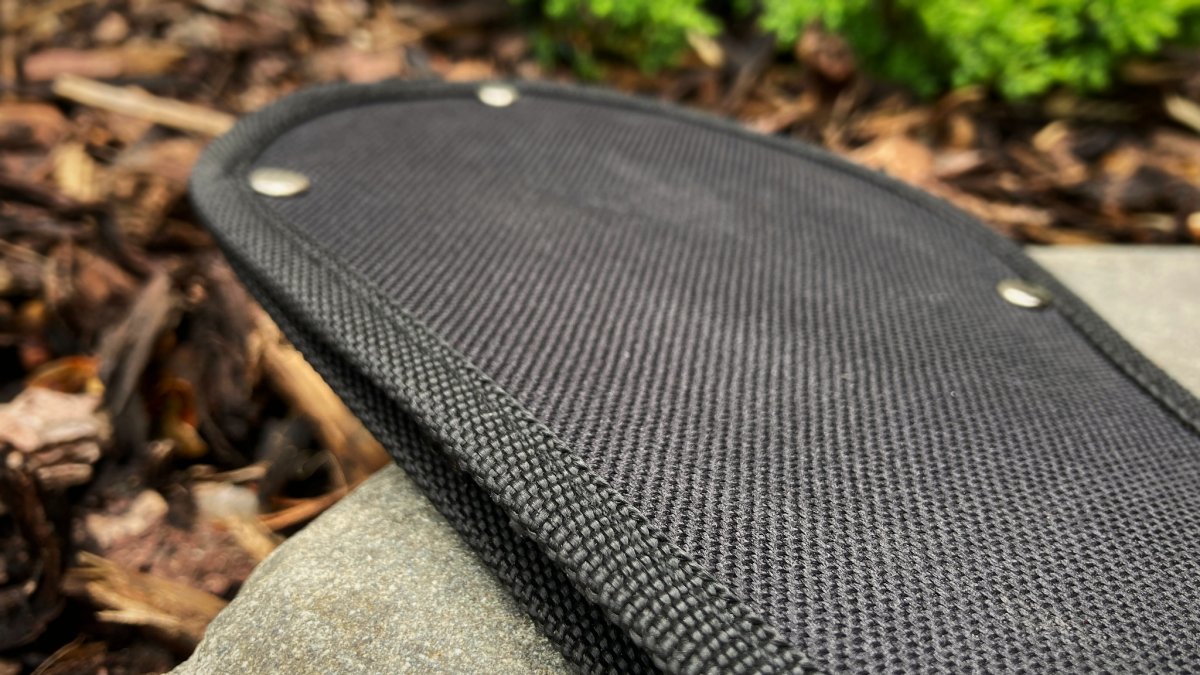
Most machetes come complete with a sheath. This makes them much easier to carry/transport and also protects them from being damaged or damaging the surroundings. Sheaths are most commonly made of nylon, cordura, kydex, hardened rubber, leather and similar flexible materials. Some sheaths are designed to be worn on a belt, some come with a shoulder strap.
maintenance
Almost every tool deserves at least some occasional maintenance, and machetes are a perfect example. Over time, their blades get dull, each use can leave dirt on it, and even the finest steel can begin to rust.
sharpening
The machete is not a katana or a scalpel, but a tool for hard work. Therefore, the angle of the cutting edge does not have to be as small as possible to split a hair. Instead, you need the blade to withstand heavy impacts, so the angle should be greater than what is usual with regular knives. It is generally said that the edge of machetes used for trimming weeds and harvesting crops should be at an angle between 20 and 25 degrees. The edge of machetes designed for more demanding tasks, such as cutting branches or trees, should have an angle between 25 and 35 degrees.
Even a regular garden tool sharpener will sharpen your machete well enough, but you can use basically anything that can sharpen knives. We offer a wide range of electric and manual sharpeners, whetstones and sharpening rods.
Every single use of a machete is likely going to leave dirt, moisture or scratches on its surface. These can affect the overall beauty of your tool, and in the case of moisture, the blade can also begin to rust - especially those made of carbon steel. Some machetes are therefore coated with a black finish to prevent this issue, but if the layer gets damaged by scratches, it loses its functionality.
That's why you should take at least a couple of minutes after each use to take care of your machete. It should always be clean and dry, and in the case of carbon steel machetes, you should occasionally apply oil to the blade, which protects it from moisture and thus prevents corrosion. And which oil should you use? Any. Whether it's gun oil, motor oil, WD-40 or even vaseline - its purpose is to prevent oxygen and water from getting in contact with the blade. That's why you can use just about anything that forms a protective layer on the blade.
If you're choosing a machete, you should ask yourself what you're going to use it for. Then you can go by the types of machetes, materials, dimensions and other features mentioned above.
For heavy work, such as chopping wood, massive machetes with long and thick blades are certainly the best choice.
On the other hand, light and compact machetes are perfect for finer woodworking, cutting meat or harvesting crops - and they are also easier to carry and not as exhausting to use.
Do you require maximum durability and don't mind occasional maintenance? Then a carbon steel blade is made just for you.
Don't want to deal with regular cleaning and oiling of the machete and don't mind higher cost? Then you'll definitely appreciate a machete with a stainless steel blade.
Ever since I was a kid I've been interested in everything that shoots, cuts, drives fast and makes noise. My hobbies include graphics, 3D printing, origami, gardening and playing videogames. As of 2023, working at Balistas, I create product description, write articles, take photos for banners and social media, and run 3D printers.
Combat knives need to be penetrating. Folding tools are good for hiking. And
survival expeditions require a knife that can cut through difficult terrain.
Simply put – the right knife is the one that suits your intended purpose.
Cookies on this website are used to personalise content and ads, provide social media features and analyse traffic. In addition, we share information about your use of the website with our social media, advertising and web analytics partners, who may combine it with other information you have provided to them or that they have collected from your use of their services.
Cookie Preferences
Essential cookies to keep the site up and running
Essential cookies help make the website usable by enabling basic functions such as site navigation and access to secure areas of the website. Without these cookies, the website cannot function properly.
Preference cookies to save your settings
Preference cookies allow a website to remember information that changes the way a website behaves or looks, such as your preferred language or the region you are in.
Analytics cookies so we can improve the website
Analytics cookies help website owners understand how visitors interact with the website by collecting and reporting information anonymously.
Marketing cookies so you don't receive advertising you're not interested in
Marketing cookies are used to track visitors across websites. The intention is to display advertisements that are relevant and engaging to the individual user and thus more valuable to publishers and third-party advertisers.





 Latin
Latin


 Kukri
Kukri


 Parang
 Golok
Golok Bolo
Bolo Panga
Panga Tapanga
 Barong
 Billhook
 Falcata