Air Rifle SPA Snowpeak T-Rex W 5.5mm
1x
> 50 pcs in stock, estimated delivery: October 26 - 28.
€ 287.7
##skip_main ##skip_menu ##skip_search

Mirka Customer Support
Your cart is empty
Add the chosen goods to your cart. Are you wondering where to begin?
Take a look at bestsellers our visit our help room.

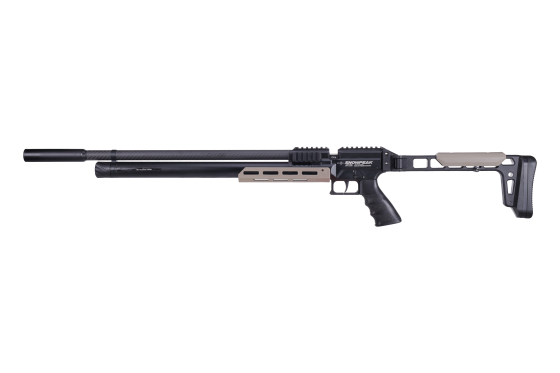
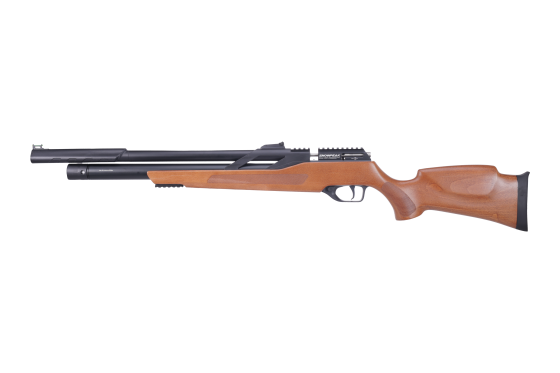
The T-Rex W is the wooden-stock version of the T-Rex PCP air rifle from Chinese manufacturer SPA (Snowpeak); only the stock and weight differ. The barrel, air cylinder, regulator and power remain the same as on the polymer-stock version, which we introduced in our first T-Rex video review. The wooden-stock version weighs 3.2 kg, 50 g more; the synthetic version also has a height-adjustable cheekpiece.
The stock is made of beech rather than walnut, but its finish is above average for this price bracket. The grip areas are textured to prevent your hand from slipping even when sweaty, and the butt pad is shaped at the top to fit comfortably into the shoulder. A weight of 3.2 kg sounds like a lot, but the air rifle is well balanced and steady in the hands.
The manufacturer has retained the lower rail on the fore-end of the wooden-stock version for attaching a bipod. That is not something you can take for granted with wooden stocks.
For the price of this entire air rifle, another manufacturer would offer just the stock.
The T-Rex W is available in 4.5, 5.5 and 6.35 mm calibres, which differ in power, magazine capacity and shot count per fill. The air cylinder has a capacity of 230 cm³ in all calibres and is filled to a maximum of 250 bar; a built-in regulator ensures consistent power. A sound moderator is integrated along the full length of the barrel.
| CALIBRE | ENERGY | MAGAZINE | SHOTS PER FILL |
| 4.5 mm | 28 J | 12 shots | 60 |
| 5.5 mm (tested) | 41 J | 10 shots | 40 |
| 6.35 mm | 49 J | 9 shots | 35 |
(Manufacturer's specifications. Common to all calibres: 480 mm barrel, 1,050 mm overall length, 3.2 kg weight, 22 mm scope rail, fibre-optic sights.)
The T-Rex W has a conventional four-step bolt action: unlock, pull back, push forward and lock. It is stiffer to cock and slower than the sidelever on the AP900 and AP1000, but the movement is positive. Anyone who shoots a centrefire rifle will recognise it and feel at home with it. The bolt handle can be moved to the left side.
The trigger is not adjustable. However, the factory setting is ideal for an air rifle in this class. The safety is plastic and sits inside the trigger guard next to the trigger. An indicator on the action shows when the air rifle is loaded.
The T-Rex magazine is a spring-loaded plastic drum that you wind up like an alarm clock before loading. In 5.5 mm calibre it holds 10 pellets, just like the AP900 and AP1000.
We tested the T-Rex W on our 50-metre range using JSB Exact Jumbo Heavy pellets weighing 1.175 g. In our first T-Rex video review, we shot on a 20-metre range and focused mainly on velocity consistency and power; such a short distance reveals little about accuracy. At 50 metres, you can see much more.
The rifle we tested was neither hand-picked nor tuned. It is a standard, out-of-the-box air rifle lent to us by a colleague. The T-Rex, AP900 and AP1000 are among the most popular air rifles at our company, and most employees own one of them. Before filming, we shot roughly twenty magazines: first we zeroed and adjusted the air rifle on paper, and only then did we shoot the targets shown here.
At 50 metres, the 5.5 mm T-Rex W delivered consistent velocities without a single flyer; the groups on both targets were smaller than the width of a thumb. The first 15 shots from two magazines varied by no more than 3 m/s on the chronograph, ranging from 271 to 274 m/s. That equates to 43.1–44.1 J. The velocity then dropped to 267–269 m/s because the air cylinder was running low and needed topping up. Even the slowest shot at 267 m/s hit accurately.
| SERIES | MEASURED VELOCITIES (M/S) |
| 1st magazine | 272 · 272 · 272 · 271 · 272 · 272 · 271 · 272 · 271 |
| 2nd magazine | 273 · 274 · 273 · 274 · 274 · 272 · 267 · 269 · 269 · 267 |
(Velocities recorded in the video, using JSB Exact Jumbo Heavy 1.175 g pellets. The last four shots were fired after the pressure dropped.)
What the measurements mean for accuracy
A difference of 3 m/s is 1.1% of the velocity. A slower pellet takes fractionally longer to travel 50 metres and drops further; according to our calculation without air resistance, the difference between the fastest and slowest shots amounts to just under 4 mm vertically, and slightly more when the pellet's deceleration in the air is taken into account. Velocity consistency therefore places virtually no limitation on accuracy at 50 metres; the barrel, pellet and shooter are what matter.
Why it measured higher than the manufacturer's specification
The manufacturer states 41 J and 263 m/s. With the same 1.175 g pellet, 263 m/s gives 40.6 J, so the catalogue figure corresponds to a pellet of that weight. Our rifle was 3.4% faster, which is why it measured 43–44 J. The difference comes from the individual rifle, not the pellet. For the 6.35 mm calibre with its catalogue rating of 49 J, this means that some rifles may exceed 50 J, above which shooting is permitted only at a shooting range.
I didn't have any flyers throughout the entire test.
We feel that the T-Rex shoots a little more accurately than the AP900 and AP1000. Barrel length cannot explain it, as the AP1000 has a barrel that is 20 mm longer. The weight, which steadies your aim (3.2 kg versus 2.3 kg), or a particularly good barrel on this individual rifle may play a part. The T-Rex W is slightly louder on firing than the AP900; we did not measure the noise, so this is an impression from shooting them side by side.
TIP:
It always varies from rifle to rifle, rather than from model to model. You have to try it for yourself.
The T-Rex W is the heaviest of the three and the steadiest in the hands, the AP900 is the lightest and quickest to cycle, and the AP1000 has the highest power in 5.5 mm calibre. All three are made by SPA and have a regulator. The T-Rex air cylinder holds 230 cm³, almost twice as much as the AP900 (118 cm³).
| 5.5 mm CALIBRE | ENERGY | WEIGHT | BARREL | AIR CYLINDER | ACTION |
| T-Rex W | 41 J | 3.2 kg | 480 mm | 230 cm³ | four-step bolt action |
| AP900 Mercury | 32 J | 1.6 kg | 310 mm | 118 cm³ | sidelever |
| AP1000 Mercury | 47.7 J | 2.3 kg | 500 mm | 250 cm³ | sidelever |
(Manufacturer's specifications.)
Anyone who wants quick, straightforward shooting will opt for the sidelever of the AP900 or AP1000; we covered both in detail in our AP900 and AP1000 video review. Those who take their time over each shot, cycle the action calmly and then fire will appreciate the T-Rex W's longer, heavier construction and wooden stock. For a compact alternative, there is the T-Rex Bullpup.
1x
> 50 pcs in stock, estimated delivery: October 26 - 28.
€ 287.7

6x
27 pcs in stock, estimated delivery: October 26 - 28.
€ 246.5
For the T-Rex W, you need a compressed air source with a quick connector, pellets and a heavy-duty pellet trap; for 50 m, we recommend a scope. The factory-fitted fibre-optic sights are sufficient for short distances, but we would definitely fit the T-Rex with a quality scope, because it deserves one.

190x
> 100 pcs in stock, estimated delivery: October 26 - 28.
€ 15.5

80x
> 100 pcs in stock, estimated delivery: October 26 - 28.
€ 188.9

8x
4 pcs in stock, estimated delivery: October 26 - 28.
€ 41.1

10x
> 50 pcs in stock, estimated delivery: October 26 - 28.
€ 411.1
Spare parts
For the T-Rex, we separately offer a spare magazine for each calibre, a filling probe, a pressure gauge and a seal kit. A second magazine is useful at the range when you do not want to reload after every ten shots.
| PROS | CONS |
| + consistent velocity thanks to the regulator | - trigger is not adjustable |
| + accuracy at 50 m with no flyers | - four-step bolt action is slower than a side lever |
| + beech stock with textured grip areas and a rail for a bipod |
- slightly louder than the AP900 |
| + large 230 cm³ air cylinder with pressure gauge | - 3.2 kg – heavier to carry than the AP900 |
| + spare parts available | - quick connector and air source must be purchased separately |
The T-Rex W is for shooters who want an affordable, accurate PCP air rifle with a wooden stock and prefer a relaxed pace, one shot at a time. Those who prioritise fast cycling and low weight will be happier with the AP900 or AP1000. We recommend the T-Rex and the other current SPA air rifles mainly to those who want to try PCP shooting without a large investment.
If you don't want to spend a lot of money on air rifles and want to find out whether you'll enjoy it, these models will serve you perfectly well.
> 50 pcs in stock, estimated delivery: October 26 - 28.
€ 287.7
You can find more regulated models in the PCP air rifles category.
How powerful is the Snowpeak T-Rex W?
According to the manufacturer, 28 J in 4.5 mm, 41 J in 5.5 mm and 49 J in 6.35 mm calibre. Our 5.5 mm rifle measured 43–44 J; the actual value varies from rifle to rifle and depending on the pellets.
What pressure do you fill the T-Rex to, and how many shots does it deliver?
A maximum of 250 bar. The manufacturer states 60 shots in 4.5 mm, 40 in 5.5 mm and 35 in 6.35 mm calibre; we did not measure the shot count per fill in our test.
Which pellets should I use in the 5.5 mm T-Rex?
We used JSB Exact Jumbo Heavy 1.175 g in the test. However, each barrel may prefer a different pellet, so it is worth starting with a test pack.
Is the T-Rex W suitable for a beginner?
Yes, provided they do not mind the 3.2 kg weight and slower four-step bolt action. It is affordable, has a regulator and spare parts are available. Those who want a lighter air rifle with fast cycling should choose the AP900.
 Secure shopping and payment fast delivery to many EU countries
 Excellent customer support from specialists – for over 15 years
 -20% on selected product in the loyalty program
 New videos and reviews every day 6000+ reviews from our customers